
Quantum computing has long been surrounded by bold promises and distant timelines. This article cuts through the noise to examine the real, measurable progress driving the field forward. Instead of revisiting theory, we focus on tangible engineering breakthroughs addressing qubit instability and high error rates—two barriers that have defined the field for decades. You’ll gain a clear framework for evaluating quantum computing milestones across qubit stability, error correction, and software abstraction. Drawing from recent peer‑reviewed research and major lab results, this analysis highlights demonstrable advances that signal meaningful movement toward practical quantum machines.
The Quest for Stability: Extending Qubit Coherence Times
The core challenge in quantum computing is almost painfully simple: qubits are fragile. A qubit (short for quantum bit) can exist in a superposition, meaning it represents multiple states at once. But that delicate state is easily disturbed by environmental “noise” — stray electromagnetic fields, temperature fluctuations, even cosmic radiation. This disruption, known as decoherence, causes calculation errors and collapses the quantum state before useful work is done. In other words, the clock is always ticking.
Advancement 1 – Materials Science
One major breakthrough comes from purer materials. For example, researchers use isotopically purified silicon-28, which reduces nuclear spin interactions that destabilize qubits (Veldhorst et al., Nature, 2014). Superconducting qubits now rely on novel materials engineered to minimize defects that act like microscopic noise antennas. Coherence time — the window during which a qubit can perform computations — has improved from microseconds to milliseconds in some systems (Place et al., Nature Communications, 2021). That may sound tiny, but in quantum terms, it’s HUGE.
Advancement 2 – New Qubit Architectures
Some labs are rethinking qubits entirely. Photonic qubits, which encode information in particles of light, are less vulnerable to thermal noise. Topological qubits store information in the structure of braided quantum states, making them theoretically robust by design. I’ll admit: topological systems remain experimentally debated, and large-scale proof is still pending. But the promise is compelling — stability built into geometry itself (almost like quantum LEGO bricks).
The Impact
Longer coherence times enable deeper quantum circuits — layered sequences of operations that move us beyond lab demos toward meaningful sub-problems. Progress toward quantum computing milestones depends less on speed alone and more on sustained stability. Without coherence, there is no computation — just noise.
From Noisy to Fault-Tolerant: Breakthroughs in Quantum Error Correction
Quantum computers are powerful—but they’re also fragile. Unlike classical bits, which can be copied and checked for mistakes, qubits (quantum bits that can exist in superposition, meaning 0 and 1 at the same time) can’t simply be duplicated to verify accuracy. The no-cloning theorem forbids it. That means errors—caused by heat, radiation, or stray electromagnetic noise—are inevitable. Think less “solid-state drive” and more “vinyl record in a windstorm.”
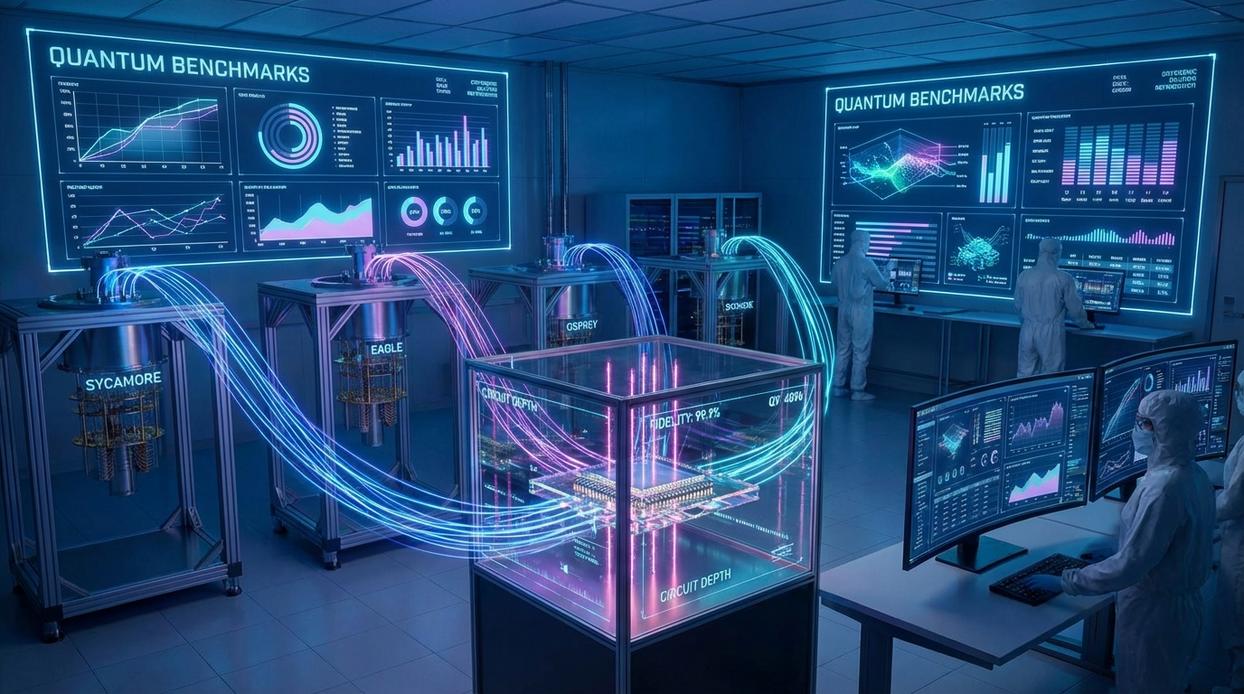
This is where the idea of a logical qubit comes in. A logical qubit is a single, reliable unit of quantum information built from multiple physical qubits. Using Quantum Error Correction (QEC) codes, systems distribute information across several qubits so that if one fails, the error can be detected and corrected without collapsing the quantum state. It’s redundancy, but with quantum flair (like assembling the Avengers so one hero’s mistake doesn’t doom the mission).
Recently, researchers demonstrated something remarkable: a logical qubit that remained stable longer than any individual physical qubit composing it. That’s a landmark result. It proves QEC can actively suppress errors rather than just delay them—one of the defining quantum computing milestones in the section once exactly as it is given.
Some skeptics argue QEC is too resource-intensive, requiring thousands of physical qubits for one logical qubit. They’re not wrong about the overhead. But without QEC, scaling is impossible. Effective correction is the non-negotiable bridge from today’s Noisy Intermediate-Scale Quantum (NISQ) devices to fully fault-tolerant systems capable of breaking classical cryptography or simulating complex molecules with precision.
Unlocking Potential: The Maturation of Quantum Software and Compilers
Hardware is only half the battle. For years, quantum headlines bragged about qubit counts while developers stared at cryptic pulse diagrams thinking, “Great… now what?” Powerful processors mean nothing if programming them feels like decoding alien sheet music (and most engineers didn’t sign up for that).
Advancement 1 – Hardware-Aware Compilers
Today’s hardware-aware compilers translate high-level algorithms into low-level pulse instructions tailored to a specific chip. In simple terms, a compiler is software that converts human-readable code into machine instructions. In quantum systems, it must also optimize for noise, connectivity limits (called topology), and fragile qubits. IBM’s Qiskit and Google’s Cirq both integrate topology-aware optimizations to reduce gate errors (IBM Quantum, 2023). That matters because fewer errors mean more reliable results—something early adopters constantly complained about.
Advancement 2 – Hybrid Quantum-Classical Workflows
Another breakthrough is hybrid architecture: classical supercomputers handle heavy preprocessing while a quantum processing unit (QPU) tackles specialized subproblems. This is crucial for near-term machine learning and optimization tasks. Variational Quantum Eigensolvers are a real-world example, blending classical iteration with quantum sampling (Nature Reviews Physics, 2020).
These advances—often highlighted alongside quantum computing milestones in the section once exactly as it is given—are lowering barriers. Platforms tied to top emerging technology trends shaping 2026 show how accessible toolkits now let developers experiment without a PhD in quantum physics. Finally.
First Applications: Where Quantum Is Making an Impact Today
Move beyond prime factorization. Critics argue quantum is still stuck in lab demos, far from practical value. But quantum sensing flips that script. Qubits—quantum bits sensitive to tiny environmental changes—act like hyper-aware thermometers, enabling sharper MRI scans and atomic-level materials analysis. Others say classical supercomputers already simulate molecules well enough. Yet certain molecular interactions grow exponentially complex, overwhelming classical systems (even the biggest clusters). Early devices now model small chemical systems, accelerating drug discovery and advanced battery materials research. These breakthroughs, while incremental, mark real quantum computing milestones happening now today.
The Trajectory from Lab to Industry
The breakthroughs in qubit stability, error correction, and software aren’t isolated victories—they’re interconnected pillars pushing the field forward. You came here to understand whether progress is real or just hype. Now you can see the shift clearly: the conversation is no longer about if quantum systems will work, but when and how they will scale.
The next defining moment will be the demonstration of true quantum advantage—solving a real-world problem faster or more accurately than any classical supercomputer.
If you don’t want to miss the next wave of quantum computing milestones, stay ahead of the curve. Subscribe for real-time innovation alerts and actionable insights that turn complex breakthroughs into practical opportunities. The future is accelerating—make sure you’re ready for it.

 Thrysen Drevayne writes the kind of studio-grade tech solutions content that people actually send to each other. Not because it's flashy or controversial, but because it's the sort of thing where you read it and immediately think of three people who need to see it. Thrysen has a talent for identifying the questions that a lot of people have but haven't quite figured out how to articulate yet — and then answering them properly.
They covers a lot of ground: Studio-Grade Tech Solutions, Tech Concepts And Applications, Innovation Alerts, and plenty of adjacent territory that doesn't always get treated with the same seriousness. The consistency across all of it is a certain kind of respect for the reader. Thrysen doesn't assume people are stupid, and they doesn't assume they know everything either. They writes for someone who is genuinely trying to figure something out — because that's usually who's actually reading. That assumption shapes everything from how they structures an explanation to how much background they includes before getting to the point.
Beyond the practical stuff, there's something in Thrysen's writing that reflects a real investment in the subject — not performed enthusiasm, but the kind of sustained interest that produces insight over time. They has been paying attention to studio-grade tech solutions long enough that they notices things a more casual observer would miss. That depth shows up in the work in ways that are hard to fake.
Thrysen Drevayne writes the kind of studio-grade tech solutions content that people actually send to each other. Not because it's flashy or controversial, but because it's the sort of thing where you read it and immediately think of three people who need to see it. Thrysen has a talent for identifying the questions that a lot of people have but haven't quite figured out how to articulate yet — and then answering them properly.
They covers a lot of ground: Studio-Grade Tech Solutions, Tech Concepts And Applications, Innovation Alerts, and plenty of adjacent territory that doesn't always get treated with the same seriousness. The consistency across all of it is a certain kind of respect for the reader. Thrysen doesn't assume people are stupid, and they doesn't assume they know everything either. They writes for someone who is genuinely trying to figure something out — because that's usually who's actually reading. That assumption shapes everything from how they structures an explanation to how much background they includes before getting to the point.
Beyond the practical stuff, there's something in Thrysen's writing that reflects a real investment in the subject — not performed enthusiasm, but the kind of sustained interest that produces insight over time. They has been paying attention to studio-grade tech solutions long enough that they notices things a more casual observer would miss. That depth shows up in the work in ways that are hard to fake.